Tuesday, May 30, 2023

Gifts from Uganda


I left Uganda 3 months ago. It was truly a life changing trip. There was so much to process. I learned, I grew, I faced challenges. My heart expanded. I felt deep pain. I felt awe.  I wanted to take time to process all of this but when I returned home, within a few days, I turned around to go to Florida to support my mother, who is elderly, frail and medically compromised. Since then I have return to the Sunshine State two more times, eventually placing her in an assisted living facility. Those trips and the all the intense emotional, physical and mental energy took my mind away from that beautiful country in East, Central Africa. And still, I think about Uganda daily. I talk w/ Ken & Faith weekly. I am still actively involved with projects there. However, I am still processing those 3 weeks on the motherland; those 3 weeks that changed my life dramatically. Travel is a fabulous and there is much to see, taste, experience and feel. But it also provides us with the opportunity to learn and grow. I want true freedom and that does not come easily or painless. So while there were many highs, there were lows as well, that invited me to go to places that were not pretty. I am grateful for it all.

I don't have the bandwidth to write all I went through and continue to process. For the sake of this blog and wanting my two small gems to know more about their earthly mother and my life, I will make things concise. If they have questions later, they can ask or they can read this and learn what this trip was like. I have shared much but not all. 

Here is some of what Uganda left me with.


1: I realized how much time and energy I spend thinking about what others having (here at home), what I don't have and how much energy I spend longing for more.

2: I am so much better off in my life than I ever realized. Seventeen years ago, when I was in Uganda. I was too young, naïve and ignorant to fully see. I was also still dealing with deep wounds that kept me from being fully present with myself, let alot fully present with the world in the deeper way I am now able to be.

3: I have so much. I am entitled. I can act like my high maintenance mother at times, especially when jet lagged or just overly tired.

4: I complain alot and talk about money. It was reflected to me that much of this comes from the culture I was raised in. Jews complain alot and talk about money alot and act like they don't have alot, even when they do. When they don't, they complain even more. I fall into all of those places.

5: I have to keep on top of my own unconscious prejudices and judgements or the just bubbling over the top of consciousness  thoughts of others. I have prejudices about cultures and genders that have not allowed me to embrace the good parts (and I am referring here to white, males here.) I also have other unconscious bias that I am now inviting more fully to the surface.

6: I like comfort. I can rough it but I like comfort too. I also need to rest, nap and take time to decompress daily. I also appreciate mosquito nets.

7: I love to see new things, new places. I love new landscapes. I loved being in the (very) remote border of the DCR/Uganda and seeing what life was life for those who life very, very much outside of first world living. I appreciated the slower and simpler way of life. It left me with a deep longing to slow things down and disconnect more from technology and modern tools, which can both help and hinder.

8: I love people. I love to get to know people. I love to help others. I loved giving out the Dr. Bronner's lip balms that were donated (approx 100) to the many sisters I met along the way. It brought a smile to my face and others. I loved the village we went to. I loved Mama Kabaswiswi, her family and I loved the joy on the faces when we shared the gifts we brought, the lanterns for light, the toothbrushes for their teeth, the soccer balls to play with. I especially loved the dances we shared. I love that village and I know I will return to support them in the near future. I love that village. Did I way that already? Well, I really love do love them.

9: I thrive in warm, tropical climates. I knew that already but it was confirmed when I spent 4 days in sub-tropical Fort Portal, at a lovely place, where the rooms were surrounded by my favorite flowers, the earth was green and lush and the days warm and just humid enough. I don't love it too hot but hot enough for there to be a little sweat and where I never have to wear socks to keep my feet warm.

10: I love the food in tropical climates. These foods; green banana, greens, yucca/cassava, mangos, etc, they are part of my DNA going back hundreds of years. My body is happy when I nourish it daily with these things.

11: I love coke zero. It's not that healthy. I know. But on a hot day, it's so refreshing. It was about 50 cents for a bottle and I loved drinking it there!! Especially when Ken and I would each have one while sharing a meal overlooking tropical gardens or Lake Victoria, while we had deep and honest conversations about our thoughts and convictions. 

12: I ask alot of questions. I am very curious. I question decisions. I often think I am right. I like to correct things. I like to find better ways to do things. Especially if it meant less time on the bumpy, unpaved roads, where we spend hours and hours.

13: I love wildlife. I love wildlife. I love wildlife. While I did not see my beloved power animal, the cheetah, I did get up close to mountain gorillas, baboons, elephants, leopards, a lion in a tree, hipps and many other animals. My soul child was very, very, very happy.

14: I realized the power of the mind to overcome hardship. Driving for hours on those roads was extremely taxing and took a toll on me on all levels. I survived. I had to trek 5 hours to see the magnificent gorillas. I got cuts, a bee sting in my face, I fell. It was really hard. I used my mind, my thoughts to make it through.

15: I learned that in life, sometimes hard work is the only way and that I am not exempt from hard work and I don't deserve a pass. I am entitled at times and don't deserve a break. I have to work hard like everyone else.

16: I love baskets! I loved buying them for those who sent things to the village so I could bring them back one and I was delighted by those I got to keep myself. I love baskets!

17: I love seeing the Creator's vast expression, in people, animals/birds/etc, the natural world. I feel deeply at peace when I see the beauty of this planet. 

18: I am deeply grateful for Ken and his family and the deepening of the relationship I have with them.

19: I am deeply grateful to my heart brother, Vincenzo, who was the best travel partner. He pulled my coat when needed. Was open to communication to process. Heard me when I pulled his coat. We mostly respected each others needs, especially when we separately hit a wall and needed alone time to rest and regroup and self-care. I learned so much from him and he was a tremendous support when I went to Florida and some of what came up in Uganda was further exposed. I went down into a dark place; facing deep shadows of my own (triggered by being with and clearly seeing my mother, who see is, how she impacted my life, the things I learned from her and what I wanted to let go off) and was able to connect the dots to what arose in Uganda. That shone a light and opened a door for some much needed healing, letting go and transformation.

20: I love Uganda. I love the people. I don't love the power politrix plays and it's impact on the masses. But the people are generally warm, kind, loving. I loved the land, the lakes, the rivers, the animals, birds, trees, flowers and just everything. I love Uganda. I always wanted to return and spend more time. I am so thankful I had this chance.

All of this and so much more from 3 weeks on the Motherland. I am so humbled by what I have been blessed to experience. Aho.


Sunday, April 16, 2023

Galentines


For Valentine's Day this year, Amara had a party based on a new trend. Galentines, where you have a party with friends where the romantic component is removed. It's just a bunch of pals hanging out. The ever thoughtful Amara decked out the living room with pink and heart decortations. We found a Valentine themed welcome mat for the front door and she had candy and gift bags for those in attendance. Amara planned out the menu including drinks and brought out the karaoke machine. She also had craft stations to make bracelets and earrings, which was a hit.

As the parent observing, I found it all very sweet. A room full of teenagers, having good, clean fun. They laughed, they crafted, they ate, they sang. It was sweet.  While I normally turn my nose at holidays, I found myself a fan of this new Galentines!


Muzunghu Driving


Before I even set foot in Rwanda/Uganda, I was warned by my Ugandan brother, Ken, that I would hear the word  muzunghu throughout my travels in Uganda. Apparently, if you are white this is the name given to you. I told Ken I was mixed and so that I should not be called that. It did not matter, he said, if you were not African you were a muzunghu. Initially, I felt a little offended, especially since I am mixed and because I felt it put me in some typical tourist category. But then when I realized there was no malice in the use of this word, I embraced it and even had fun with the term. There are not many non-African tourists traveling throughout Uganda. Those who do stick to the safari route. We were not the typical tourist and made our way down unpaved roads, into local eateries and places where many of the locals did not often, if ever see a muzunghu. Ken told me that in the village we would be visiting, there was a lot of excitement and anticipation to see not one but two muzunghu. So, I practiced how to say it, even told the family of the new name I'd have and off I went and with me the idea to really go with the term.

Thus, when I got to to Uganda and would talk with people who were looking at me with curiosity (and I heard them whisper the word), I would make a friendly gesture or say hello. When I was trying to bargain one of the (too) many baskets I wanted to bring home, I would say, "No muzunghu prices. African prices." That would often get a laugh but the bargaining would then continue to the point where my brother, Ken and even our hired driver, would join in with the same sentiments. They were relentless by the way, in getting non muzunghu prices, resulting in the acquisition of many lovely baskets (which I mostly gifted upon my return.) When I was driving the car myself, people were quite surprised to see me behind the wheel. I was told I drove like I always drove on the left side of the road (well, I did learn to drive manual transmission in Jamaica, which is also on the colonial left side of the road), and that I seemed to understand the Uganda roads quite well (only 26% of the country is paved!).  When I would park and folx would stop and stare, I'd get out of the care and say in a loud, playful tone, "muzunghu driving." I had a lot of fun with that one. When Ken's wife did my hair, we joked about my slippery muzunghu texture. The overall feel, where ever I went was that while I was a muzunghu, people were friendly, curious, welcoming and warm. There was not hatred, anger or fear, as I have too often heard with other labels of other people.

When I was preparing to leave Uganda, I realized that a shift had occurred. While I had initially felt resistant and offended to be labeled and given this name for a non-African it hit me that I would miss hearing the daily calling to me, muzunghu. It had become something like a sweet nickname. As I packed my bags I knew the next time I set food in Uganda and someone said, muzunghu, it would feel like coming home.

(here are random photos))


The Road to Kisoro


 We knew that when we would head into Uganda, we would go overland and cross the border in the western part of the country. 17 years ago Don & I went flew into Kampala from safari and immediately began a ten hour car ride to Kisoro. The roads were paved and so the scenery stuff of movies. It was easy to sit for hours and look out at the emerald green landscapes, terraced farms and all the people, working so hard but in colors that were bright and festive.  

So when we knew we had a 3 hour drive to the Uganda border, I was excited to see the landscape, and how people lived in Rwanda.  It was very interesting, the similarities, reminding me that borders and politics really are meaningless. People are people and culture is more influential. Still, it was interesting to see how very few cars were on how many people walking riding bicycles. There were so many people who were carrying produce and products to and from markets, heavy loads on their heads or other bicycles sometimes needing two or three young men to push the bicycle up the endless hills. 

Like its neighbor, Rwanda is a deep emerald green, and has read earth and terraced farms that produce corn as far as the eye can see. There was also cabbage and other vegetables along with some livestock, but the thing that stood out was the people just walking up and down the roads, young and all the like coming and going knowing that they have been doing this for their whole life.  People spend most of their life  on small farms and in small village, the weekly trip to the market their main outlet into the world. 

It was such a stark difference from own life and it forced me to look at my own life experience, and how my own privilege has allowed me to see the world in a different way. For me, personally, being abandoned at birth, and then raising a family, not in my own biological origination has allowed for me to have a very privileged and blessed life. Although I use the word, blessed lightly because everybody’s blessed even if they don’t have the privilege that I have. But as I saw along the long road to the border, the reality of my everyday existence and those around me; it felt imbalanced. I had more in terms of things like money or conditions (indoor plumbing, running, drinkable water, electricity) and  yet, in the 'first world' nations, we are so disconnected from the earth, our families, our neighbors and ourselves. Having so little distractions (like wifi, a car to take you to and from work, school, social activities), even for short time I am here, I find it easier to listen within, to make a point to connect with others, to be in the present more. I don't think either is better (well some aspects are more balanced for sure) but perhaps there is a middle ground where more of us meet in the middle. Where we all have the access we need to thrive not just survive and laugh but also remain connected to the earth and each other. I don't know for sure. It is far too complex to even comprehend let alone to put into words in one small blogpost. But as I drove along that long road, I realized that this planet is large and there are many, many different ways of living and that we all deserve dignity, opportunity


Thursday, February 23, 2023

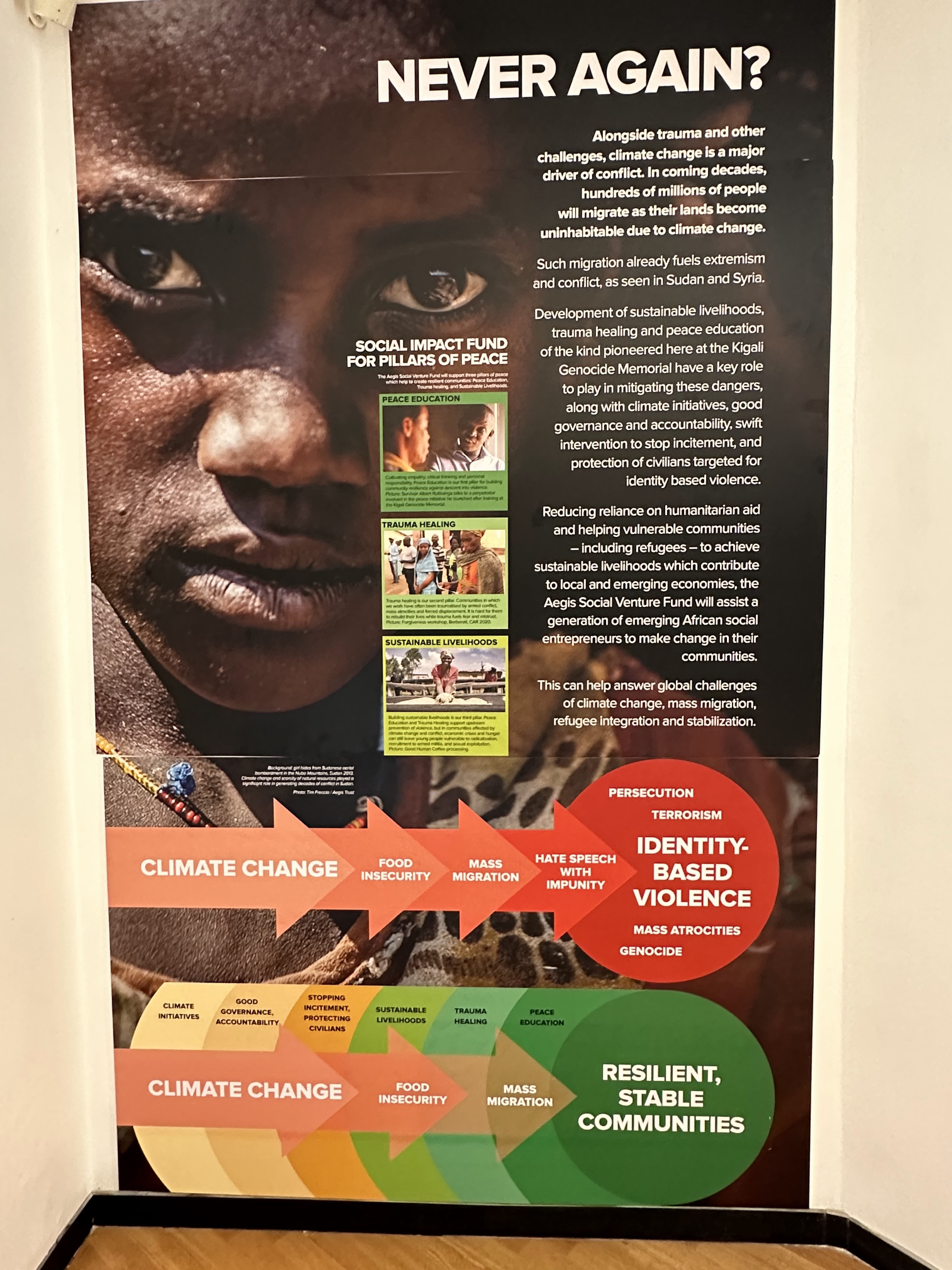
Rwanda Genocide


When my brother and I first started discussing going to Africa, one of the things that he brought up first was going to visit the Rwanda genocide sites. We both share the passion for human rights and in our own small way we work to to right injustices in the world.  That includes having to do our own personal work around our own implicit biases, unconscious racism and conscious racism.

In our much younger lives, when we were still children, we both experienced targeted hatred that left permanent scars. Perhaps it is those scares that left us wanting to do better in the world as we moved into adulthood.  Growing up in a Jewish home antisemitism was rampant and I was the direct victim on many occasions. Going to Hebrew school for years, I was not shielded from the atrocities of the holocaust. And still it wasn’t until I visited Yad Vhshem at age 13  did the stark dark reality of genocide fully hit home. I knew that going to Rwanda meant that I had to go to that memorial site and pay respect. I had to face the horrors of this genocide with eyes wide open. I knew it would be painful and still nothing could prepare me for what I saw.

I knew the numbers, the casualties, and the death, rape torture mutilation but to listen to the stories of survivors in their own words (through video), to see their photos, to see their clothing hanging in display, and to see the skulls and bones of those a few bodies of the over one million that died was overwhelming and life altering.

One of the things I read was about a little girl whose parents were killed, and at four years old, she was orphaned and had to sleep under a banana tree. And she was one of hundreds of thousands of orphaned children. At that point in the museum, I had to find a quiet bench, and just allow myself to shed tears of deep horror and pain. Hundreds of thousands of people were left with no families. Hundreds of thousands of people are orphaned. It was beyond devastating to see the reality in front of my eyes to pictures and to hear their voices. What stood out the most is that the world stood by allowed this and even more horrifying, even encouraged it with the help of foreign support.  

We always ask ourselves, "how could this happen?" once it is all over. Yet, we see this type of atrocity repeated again and again. The museum did a great job explaining about the propaganda that went on to split people amongst each other. The imperialist-colonists started it and after a barrage of media campaigns, over an extended period of time, the people turned against each out in a way that brought mass destruction. While I stood there looking at photos and reading the history, I could not  help but reflect on the propaganda that is going on in  in the United States of America right now.  What happened in Rwanda is happening in other places of the world. It is happening in the land I call home. The propaganda that is being spread a dangerous seed. 

At the heart of much of the propaganda was racism and entitlement. The wreckage of colonialism and imperialism in Africa, and other pieces in the world, have led to some of the most horrific catastrophes. Here in Rwanda millions of people died because a European country decided that they had the right to the riches of the land and wanted to separate and split the people into hating each other so that they would prosper in the end.  There was no separation of ethnic groups until the colonizers made it so. Then, once there were two groups, they were pitted against each other until we were left we a genocide so horrible that there are no words to fully describe it. We saw on display some of the clubs, hoes, and other tools that were used to mutilate children, women and men; people whose only crime was that they were labeled a different ethnic group by the Europeans. The end result was genocide and trauma for those who lived. There are thousands and thousands of people who grew up without parents and their siblings, and I’ve had to make their way in the world, Karen, such deep, brutalizing trauma.

We were fortunate to meet a lovely fellow, who helped with transportation during our time in the city, and he felt comfortable enough to share with us that he was 3 years old Genocide happen. And that’s about all he said. I don’t ask anymore questions and I did not want to pry to pray. And, I didn’t really want to know. I had already seen enough to break my heart over and over. 

We left rocks on the mass grave site, a Jewish custom. There are about one hundred thousand people buried at the museum site but so many more were left on the sides of the roads, in ditches, or in their own homes. I also read a prayer written about forgiveness for the world. We must be aware of the past, and we must do what we can to help promote healing in the present so that the future does not repeat itself. It is the least we can do if we are to ever walk in balance with each other on this earth.

When I go home, I will share these things with my two small gems and with those who ask my travels. We must keep the truth alive.


17!!!!!!!!!!!!!!!!!

Havana is now 17! One more year until she reaches that milestone adulthood birthday. And while she is in her last year of childhood, Havana ...